
Crochet Sweater: A Beautiful and Cozy Riverbed Cardigan
The Riverbed Cardigan is a relaxed, textured garment that combines simple crochet stitches with a distinctive multicolored design. This crochet pattern, created by Daniela of CJ Design Blog, features a generous oversized fit, comfortable sleeves, and ribbed finishing details.
Inspired by the stitch combination used in the designer’s Riverbed Blanket, the cardigan transforms textured crochet fabric into a practical layering piece. Its construction uses separate panels, making it possible to adjust the body and sleeve lengths to suit individual preferences. CJ Design Blog
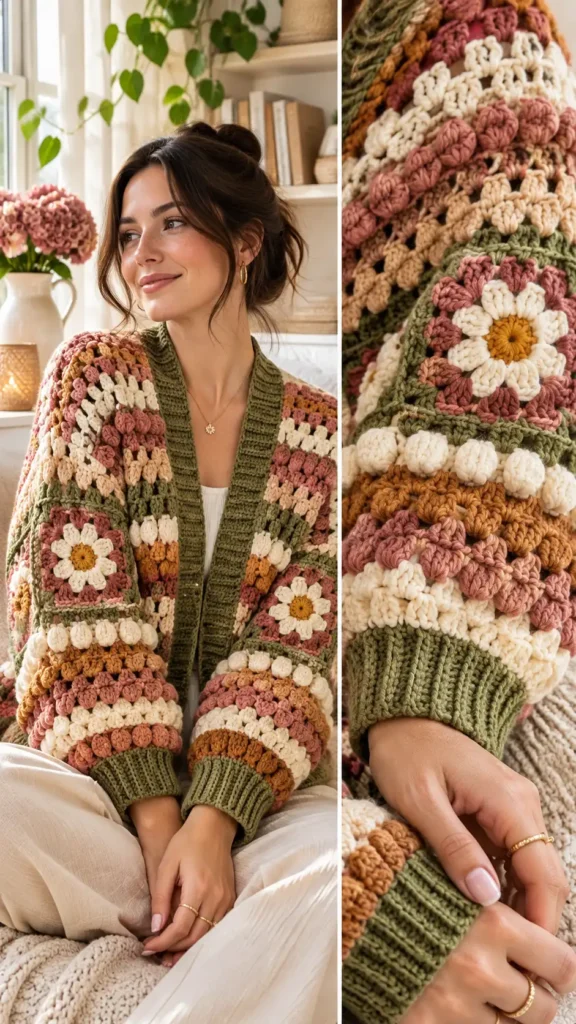
Table of Contents
Understanding the Riverbed Cardigan Design
The Riverbed Cardigan combines double crochet stitches, chain spaces, and clusters to produce a textured fabric with repeating horizontal color changes.
The original design uses four yarn colors, with contrasting shades appearing throughout the body and sleeves. A coordinated ribbed edging completes the garment.
One of its defining features is its generous fit. The designer specifies approximately 14 inches of positive ease, meaning the finished cardigan is considerably wider than the standard bust measurement associated with its size.
Choosing the Right Size
The original pattern includes eight sizes:
| Size | Standard bust | Approx. finished circumference |
|---|---|---|
| XS | 30 in | 44 in |
| S | 34 in | 48 in |
| M | 38 in | 52 in |
| L | 42 in | 56 in |
| XL | 46 in | 60 in |
| XXL | 50 in | 64 in |
| 3XL | 54 in | 68 in |
| 4XL | 58 in | 72 in |
These approximate finished circumferences reflect the designer’s stated 14-inch positive ease.
For the intended oversized appearance, choose your usual size after checking the measurements. The designer suggests sizing down substantially for a less voluminous fit.
Materials for the Riverbed Cardigan Crochet Pattern
The project uses category 4 worsted-weight yarn and a 5.5 mm crochet hook.
Yarn and Colors
The designer used Lion Brand Color Theory yarn in four shades:
- Canyon: Color A, also used for the ribbing
- Himalayan Salt: Color B
- Ivory: Color C
- Raisin: Color D
The yarn requirements vary by size. The following quantities apply to each of the four main colors, with an additional quantity needed for the ribbed edging.
| Size | Each main color | Extra ribbing yarn |
|---|---|---|
| XS | 120 g / 270 m | 88 g / 198 m |
| S | 130 g / 293 m | 93 g / 210 m |
| M | 140 g / 315 m | 100 g / 225 m |
| L | 150 g / 338 m | 110 g / 248 m |
| XL | 168 g / 378 m | 115 g / 259 m |
| XXL | 184 g / 414 m | 125 g / 282 m |
| 3XL | 192 g / 432 m | 130 g / 293 m |
| 4XL | 200 g / 450 m | 140 g / 315 m |
The ribbing allocation is separate from the quantities listed for the main colors, including Color A.
Tools and Accessories
- 5.5 mm crochet hook
- Scissors
- Tapestry needle
- Stitch markers
Crochet Stitches, Abbreviations, and Gauge
The Riverbed Cardigan uses US crochet terminology.
Stitches Used
| Abbreviation | Meaning |
|---|---|
| ch | Chain |
| st / sts | Stitch / stitches |
| sl st | Slip stitch |
| sc | Single crochet |
| dc | Double crochet |
| BLO | Back loop only |
| cl | Cluster of three double crochet stitches worked into the same space |
The pattern combines these familiar techniques to create its textured surface and flexible ribbed edges.
Gauge Information
The designer specifies the following gauge for the main textured stitch pattern:
4 × 4 inches (10 × 10 cm): 14 stitches × 9 rows
Checking gauge is particularly important when making a garment. Even a small difference in stitch size can affect the overall width and length of the finished cardigan.
How the Riverbed Cardigan Is Constructed
The cardigan is made from separate crocheted sections that are joined together before the neckline edging is added.
The following overview explains the construction without reproducing the designer’s complete written instructions.
Back Panel
The back panel begins with a ribbed section made using single crochet stitches worked through the back loops.
After completing the ribbing, the main fabric is worked along its edge. Rows of double crochet and clusters create the characteristic Riverbed texture.
The panel forms the back of the garment, extending from the lower hem toward the shoulders.
Front Panels
Two separate front panels form the open front of the cardigan.
Like the back, each panel begins with ribbing before transitioning into the main textured stitch pattern.
The front sections are designed to work with the back panel while leaving an opening for the collar.
Sleeves
The sleeves are constructed separately, beginning with narrow ribbed cuffs.
The textured fabric is then worked outward from the cuff, creating the fuller sleeve shape associated with the oversized design.
Both sleeves are completed before being attached to the body.
Joining the Cardigan
The assembly involves joining the shoulder seams, attaching the sleeves, and closing the side and sleeve seams.
The designer uses whip stitch for the assembly and recommends aligning the rows carefully so the color changes remain consistent across adjoining sections.
Adding the Ribbed Collar
The cardigan is completed with a ribbed edging worked around the front openings and neckline.
This edging is crocheted directly onto the garment, creating a coordinated finish that complements the hem and cuffs.
Adjusting the Fit and Length
The panel-based construction makes several modifications possible.
Changing the Body Length
The designer explains that the garment can be lengthened by adding rows to the front and back panels.
For a shorter cardigan, the number of body rows can be reduced.
Changes should be made consistently across corresponding sections so the garment remains balanced.
Adjusting Sleeve Length
Sleeve length can be modified by working more or fewer rows.
Trying on the garment during construction helps establish whether the length and overall proportions suit the wearer.
Working With Different Colors
Although the sample cardigan uses four alternating shades, the designer also supports a single-color version.
The original uses frequent yarn changes, with the magic knot method suggested as a way to manage those transitions and reduce loose ends.
Washing and Blocking Your Cardigan
The designer recommends washing or steam-blocking the finished garment to help the stitches relax and improve the appearance of the fabric.
Blocking can be particularly useful for a cardigan featuring clusters and textured stitch sections.
The original sample was made with acrylic yarn and steam-blocked before being photographed.
Always check the care instructions for your chosen yarn before applying heat, washing, or blocking.
A Comfortable Crochet Project With Room for Personalization
The Riverbed Cardigan offers a combination of textured stitching, roomy construction, and adaptable proportions.
Its separate panels make adjustments straightforward, while the ribbed cuffs, hem, and collar provide a consistent finish throughout the garment.
Crocheters comfortable with basic stitches, textured clusters, and garment assembly can use the original pattern to create a cardigan suited to their preferred fit and color palette.
Leave a Reply