Crochet Sweater: Easy and Beautiful Ribbed Pullover Pattern
A handmade Crochet Sweater is a wonderful addition to a comfortable, everyday wardrobe, especially when it combines a relaxed fit with beautiful texture. The Amalfi Ribbed Sweater, designed by For the Frills, features an oversized silhouette, soft ribbing, loose sleeves, and a classic round neckline. Its distinctive stitch pattern creates the appearance of knitted fabric using basic crochet techniques.
This easy-level project is particularly appealing to crocheters who want to explore garment making without relying on complicated stitch combinations. By alternating back-loop slip stitches and double crochet stitches, the design produces pronounced vertical ribs while maintaining a flexible fabric.
The sweater is constructed from separate panels, making its overall structure relatively straightforward to understand. However, achieving the intended fit requires careful attention to gauge, yarn selection, and stitch tension.
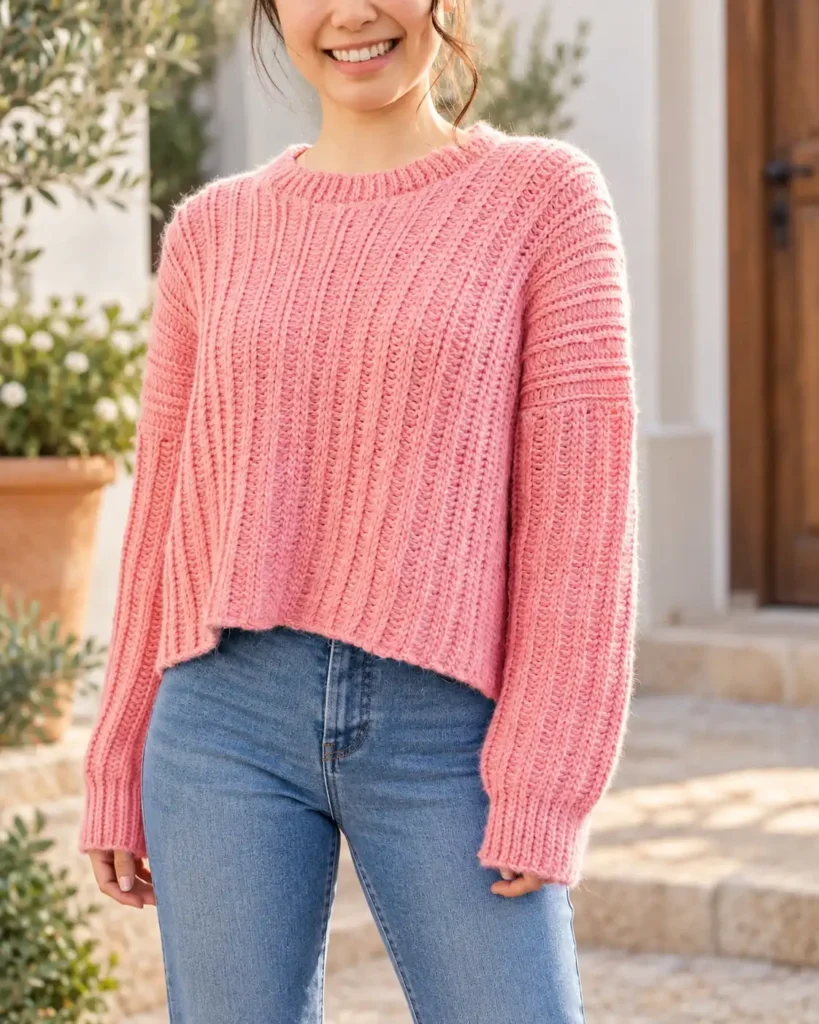
Table of Contents
Understanding the Ribbed Crochet Sweater Design
The Amalfi Sweater has a simple, boxy shape with generous room through the body and sleeves. Its ribbed texture gives the garment visual interest without requiring decorative cables or elaborate stitch patterns.
Several design elements contribute to its appearance:
- Oversized body: Creates a loose, comfortable silhouette suitable for layering.
- Knit-look ribbing: Combines slip stitches and double crochet stitches worked through the back loops.
- Relaxed sleeves: Complement the sweater’s roomy construction.
- Round neckline: Finished with a separate ribbed band for a neat appearance.
- Optional bottom ribbing: Allows the sweater to have either a more structured hem or a shorter, casual finish.
The designer presents both hemline options, allowing crocheters to choose the finish they prefer.
How the Ribbed Texture Is Created
Unlike many crochet garments worked upward from the hem, this sweater is crocheted lengthwise. The foundation chain establishes the length of each panel, while subsequent rows build its width.
The textured fabric uses two primary stitch techniques:
Back Loop Slip Stitch (BLO sl st): Working slip stitches into the back loops creates compact, flexible rows that help define the ribbed structure.
Back Loop Double Crochet (BLO DC): Taller double crochet stitches provide contrast with the shorter slip stitch rows, creating raised sections that resemble knitted ribs.
The original pattern organizes these stitches into a four-row repeat. Once the sequence becomes familiar, the main panels use a consistent rhythm.
Maintaining relaxed slip stitches is important. Tight stitches can make it difficult to insert the hook into the following row and may affect the fabric’s stretch and dimensions.
How the Crochet Sweater Is Constructed
The Amalfi Sweater consists of four main crocheted pieces:
- One back panel.
- One front panel with neckline shaping.
- Two sleeves.
- Separate ribbed finishing bands for the neckline and optional lower hem.
The panels are worked individually before being joined with sewn seams.
Back Panel
The back panel forms the main rectangular section of the sweater.
It is worked sideways using the repeating ribbed stitch pattern. Because the foundation chain determines the garment’s length, checking measurements before beginning is particularly important.
The width develops as additional rows are completed, allowing the panel to gradually reach the dimensions specified for the selected size.
Front Panel and Neckline Shaping
The front panel uses the same textured stitch pattern as the back, but includes additional shaping to form the round neckline.
Rather than creating a smooth curve directly, the pattern uses changes in row length to produce a stepped neckline edge.
These temporary corners are part of the intended construction. The separately crocheted neckline band covers them during finishing, creating a smoother appearance.
Sleeves
Both sleeves are crocheted sideways to maintain the same ribbed direction as the body.
The sleeve construction incorporates slip stitches near the cuff area, helping create a different texture at the wrist.
Once each sleeve is completed, it is folded lengthwise and sewn along its edges to form a tube.
The sleeves are then attached to the armholes during assembly.
Inspiration Behind the Knit-Look Texture
The designer developed the Amalfi Sweater around the idea of creating a wearable autumn pullover with substantial ribbing and a relaxed shape.
Traditional crochet ribbing techniques can produce attractive results, but their appearance and thickness vary.
Back-loop half double crochet is often used to create flexible ribbed fabric. However, its consistent stitch height offers less variation in the thickness of individual ribs.
Front-post and back-post double crochet stitches provide another approach, although they can create a thicker fabric and may require more yarn.
For this design, the combination of back-loop slip stitches and double crochet stitches provides an alternative.
The resulting texture is prominent without depending on post stitches throughout the garment.
The original sample was made in Dogwood Heather, a warm peach-pink shade with subtle variations in color. According to the designer, the yarn can appear more pink or coral depending on the lighting.
Choosing Yarn for the Amalfi Sweater
Yarn selection plays an important role in the finished appearance of this garment.
The original sweater uses WeCrochet Andean Treasure, a 100% baby alpaca yarn.
Although the manufacturer classifies it as Sport/Fine weight (2), the designer describes its thickness as closer to a substantial DK yarn or a particularly fine worsted-weight yarn.
This distinction matters when considering alternative yarns.
The sweater’s lengthwise construction means that the drape and gauge of the fabric directly influence how the garment hangs on the body.
A yarn that creates a stiff fabric may produce a different silhouette from the soft, flowing result shown in the original design.
Original Yarn Specifications
| Detail | Specification |
|---|---|
| Yarn | WeCrochet Andean Treasure |
| Fiber | 100% baby alpaca |
| Classified weight | Sport / Fine (2) |
| Yarn length | 100 m / 110 yd per 50 g |
| Sample color | Dogwood Heather |
| Suggested alternative weight | DK, subject to gauge |
The designer recommends making a gauge swatch before substituting yarn.
Matching the yarn-weight label alone does not guarantee the same dimensions or fabric behavior.
Materials Needed for the Crochet Sweater
The original pattern specifies the following materials:
- WeCrochet Andean Treasure yarn, or a suitable yarn that meets the pattern gauge.
- 5 mm (US H) crochet hook.
- Darning needle for assembly and weaving in ends.
- Scissors.
- Stitch markers or safety pins.
Yarn Quantities by Size
The original yarn requirements include the sweater and its lower hem ribbing.
| Size | Approximate yarn required |
|---|---|
| XS | 535 g |
| S | 585 g |
| M | 635 g |
| L | 695 g |
| XL | 765 g |
| 2XL | 820 g |
| 3XL | 900 g |
| 4XL | 960 g |
| 5XL | 1,005 g |
These quantities apply to the specified yarn and design. Different yarns or modifications may change the amount required.
Crochet Stitches and Abbreviations
The Amalfi Sweater pattern uses US crochet terminology.
Understanding the following abbreviations will make the original instructions easier to follow.
| Abbreviation | Meaning |
|---|---|
| Ch | Chain |
| Sl st | Slip stitch |
| DC | Double crochet |
| BLO | Back loop only |
| St(s) | Stitch(es) |
| Rep | Repeat |
| Sk | Skip |
| RS | Right side |
| WS | Wrong side |
The principal fabric uses back-loop slip stitches and back-loop double crochet stitches.
Although the stitches themselves are basic, consistent tension is especially important when working repeated slip-stitch rows.
Sweater Sizing and Finished Measurements
The Amalfi Sweater is available in nine sizes, from XS through 5XL.
The designer recommends choosing your usual T-shirt size for the intended oversized appearance. For crocheters between sizes, the original guidance suggests sizing down.
The fabric is stretchy, and the designer notes that the sweater width may increase by approximately 3–5 cm (1–2 inches) after repeated wear.
Size and Length Reference
The following measurements come from the original pattern.
| Size | Bust size to fit | Sweater length with ribbing |
|---|---|---|
| XS | 71 cm / 28 in | 51 cm / 20 in |
| S | 81 cm / 32 in | 51 cm / 20 in |
| M | 91 cm / 36 in | 53 cm / 21 in |
| L | 101 cm / 40 in | 53 cm / 21 in |
| XL | 112 cm / 44 in | 56 cm / 22 in |
| 2XL | 122 cm / 48 in | 56 cm / 22 in |
| 3XL | 132 cm / 52 in | 58 cm / 23 in |
| 4XL | 142 cm / 56 in | 58 cm / 23 in |
| 5XL | 152 cm / 60 in | 61 cm / 24 in |
The bust figures indicate the body measurements each size is intended to fit, not the finished garment circumference.
The sample shown by the designer is a size small, modeled on someone approximately 5 ft 3 in tall with a 32-inch bust.
Checking the Crochet Gauge
The specified gauge is:
10 cm × 10 cm (4 in × 4 in) = 16.5 stitches wide × 21 rows tall, measured in the knit-look rib stitch pattern.
The gauge sample contains five double crochet rows and sixteen slip-stitch rows.
A gauge swatch is particularly valuable for this sweater because the panels are worked sideways. An incorrect gauge can affect the garment’s width and length.
The designer emphasizes keeping slip stitches loose enough to work comfortably into their back loops.
If the stitches are consistently difficult to enter, a larger crochet hook may help, provided the resulting fabric meets the required gauge.
Tips for Creating an Even Knit-Look Fabric
The textured surface is the defining feature of this sweater, so consistent stitch formation deserves attention.
Keep Slip Stitches Relaxed
Slip stitches are naturally shorter and more compact than double crochet stitches.
Pulling them too tightly can make the next row difficult to work and may reduce the fabric’s flexibility.
A relaxed tension helps maintain a more even surface.
Check Measurements Before Building the Panels
Because the sweater is worked lengthwise, changing the length later is less straightforward than with a bottom-up construction.
The original design allows the foundation chain to be adjusted for a different length, but such changes can also affect yarn requirements.
Checking gauge and planned measurements before starting the full panels helps avoid unnecessary reworking.
Pay Attention to Rib Alignment
The ribs should align neatly when the sweater pieces are assembled.
During sewing, matching the textured sections on adjoining panels helps create a more continuous appearance.
Video Tutorial and Complete Crochet Pattern
The original designer provides a video tutorial alongside the written pattern.
The video offers a visual reference for the ribbed stitch texture, garment construction, and finishing process.
The full written instructions include separate directions for the back panel, front panel, neckline shaping, sleeves, assembly, and finishing bands.
Assembling the Sweater
After completing the four main pieces, the sweater is joined using sewn seams.
The original pattern uses whip stitching for assembly.
The front and back panels are joined at the shoulders, followed by the side seams, leaving openings for the sleeves.
Each sleeve is sewn into its corresponding armhole.
The designer also recommends aligning the ribbing carefully when sewing to create neat joins.
Adding the Round Neckline
The neckline band is crocheted separately using slip-stitch ribbing.
It is designed to stretch around the neck opening while maintaining a relatively flat finish.
During attachment, the ribbed band covers the stepped edges created by the front-panel shaping.
The designer cautions against making the band excessively long because extra fabric may cause the neckline to ripple rather than lie flat.
Choosing the Bottom Hem Finish
The lower hem ribbing is optional.
Without the additional band, the sweater has a shorter appearance and a more casual edge.
Adding the ribbing creates a more defined lower border and increases the finished length.
Both versions use the same main sweater construction, allowing the finishing choice to be made according to the desired appearance.
Completing the Final Details
The final stage involves attaching the finishing bands, securing the seams, and weaving in the yarn ends.
The original instructions use stitch markers to position the neckline ribbing before sewing, helping distribute the band around the opening.
Careful finishing allows the ribbed texture to remain the main visual feature while giving the garment a cohesive shape.
Is this conversation helpful so far?
Conclusion
The Amalfi Ribbed Crochet Sweater is a lovely project for crocheters who want to create a comfortable, handmade garment with a classic knit-inspired appearance. Its relaxed silhouette, textured ribbing, and simple construction make it an appealing choice for exploring crochet clothing.
By working the body and sleeves in separate panels, the design keeps the construction approachable while introducing useful garment-making techniques. The combination of back-loop slip stitches and double crochet stitches creates a distinctive fabric that gives the finished sweater its character.
Whether you choose the shorter hemline or add the optional bottom ribbing, this sweater offers a versatile style for everyday wear. Take time to check your gauge, maintain consistent tension, and carefully assemble the pieces for a neat finish.
Frequently Asked Questions About the Crochet Sweater
1. Is the Amalfi Ribbed Crochet Sweater suitable for beginners?
Yes. The designer describes the Amalfi Sweater as an easy-level crochet project. It primarily uses slip stitches and double crochet stitches worked through the back loops.
However, crocheters should be comfortable following stitch repeats, maintaining consistent tension, and sewing separate pieces together. Beginners who already understand basic crochet techniques can use this project to develop their garment-making skills.
2. Can I use a different yarn for this Crochet Sweater?
Yes, but choosing a replacement yarn requires attention to gauge and fabric texture.
The original pattern uses WeCrochet Andean Treasure, a 100% baby alpaca yarn classified as Sport/Fine weight. The designer notes that its thickness is closer to DK yarn.
If you select another yarn, make a gauge swatch before beginning. The substitute should produce the required stitch and row gauge while creating a fabric with suitable flexibility and drape.
3. Why are my back-loop slip stitches difficult to crochet?
Back-loop slip stitches can become difficult to work when the yarn is pulled too tightly.
Because slip stitches are naturally compact, excessive tension makes inserting the hook into the following row challenging.
Try relaxing your grip and allowing each stitch to remain slightly loose. If necessary, experiment with a larger hook while checking that your gauge still matches the original pattern.
Consistent tension helps create more even ribbing throughout the sweater.
4. Can I make the Amalfi Crochet Sweater longer or shorter?
Yes. The sweater’s lengthwise construction allows adjustments to the foundation chain to change the length of the main panels.
However, modifying the original dimensions can affect the amount of yarn required and the finished proportions.
The pattern also offers optional bottom ribbing, which provides another way to change the sweater’s overall length and appearance without altering the main construction.
Leave a Reply