
Crochet Pattern for a Beautiful Daisy Garden Diamond Table Runner
The Daisy Garden Diamond Runner Crochet Pattern brings together delicate lacework, textured flowers, and geometric shapes to create an elegant handmade table decoration. Featuring white daisies, soft green leaves, and an open diamond framework, this project combines traditional crochet techniques with a fresh botanical design.
Designed for intermediate crocheters, the runner involves making individual floral motifs, constructing decorative lace sections, and connecting the elements into a coordinated piece. Its combination of solid stitches and open spaces creates an attractive balance of texture and lightness.
Whether displayed on a dining table, sideboard, or console, this floral runner offers a decorative way to incorporate handmade crochet into everyday home styling.
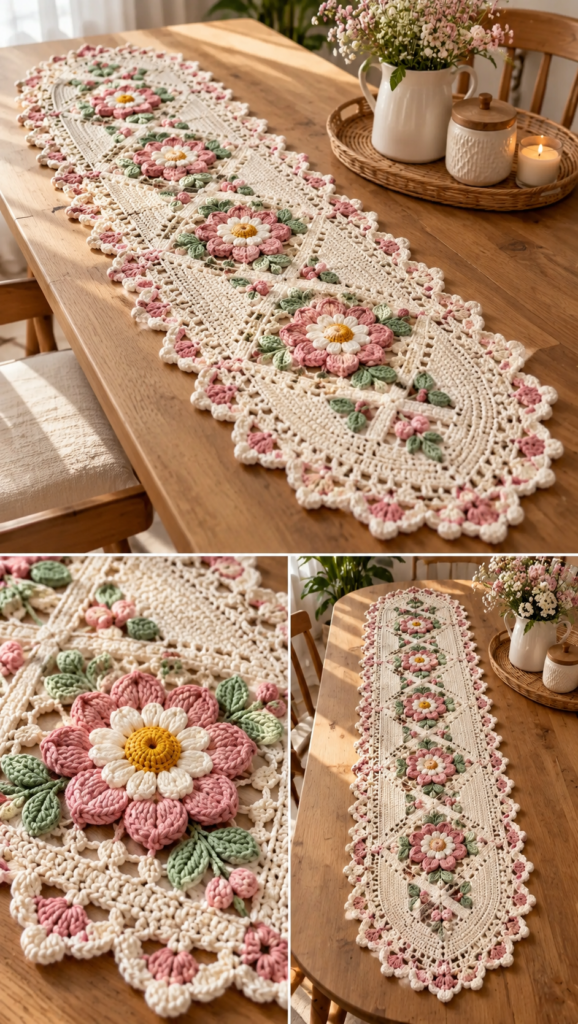
Table of Contents
What Makes This Floral Table Runner Special?
The Daisy Garden Diamond Runner features a repeating arrangement of flowers surrounded by diamond-shaped lace panels. Each floral motif sits within a geometric framework, creating a consistent pattern along the length of the runner.
Several details contribute to its distinctive appearance:
- Raised daisy petals: White crocheted flowers add dimension against the flatter lace background.
- Diamond-shaped openings: Solid single crochet sections alternate with chain spaces to form the geometric structure.
- Soft botanical colors: Yellow flower centers, pale mint leaves, and subtle pink details complement the cream-colored base.
- Tapered ends: The runner narrows into rounded points, giving the finished piece an elongated silhouette.
- Decorative edging: Fan-shaped lace and small picot details complete the perimeter.
The combination of floral motifs and openwork makes this design particularly suitable for spring and summer decorating, although its neutral background can complement year-round interiors.
The construction is divided into manageable components. Flowers and leaves are prepared separately, while the surrounding lacework provides the structure that connects them.
Because the design requires shaping, motif placement, and joining techniques, the original designer classifies it as an intermediate-level project. Crocheters familiar with granny squares, basic stitches, and working individual motifs will recognize several of the techniques involved.
Materials for the Daisy Garden Crochet Pattern
The original project uses fine cotton thread or lace-weight cotton yarn to achieve a delicate appearance and clearly defined stitches.
Yarn and Color Selection
The suggested palette includes:
- Cream or ivory fine cotton thread or lace-weight yarn for the main runner.
- White cotton yarn for the daisy petals.
- Yellow yarn for the flower centers.
- Pale mint yarn for the decorative leaves.
- Light pink yarn for small accent details.
Cotton is especially appropriate for this type of lacework because it helps the stitches retain their definition after blocking.
The original article also recommends size 10 crochet cotton as an option for crocheters beginning to work with fine thread.
Crochet Hooks and Accessories
The materials specified for the project include:
- A crochet hook measuring approximately 1.75 mm to 2.25 mm, chosen according to the thread.
- A yarn needle for securing loose ends.
- Scissors for cutting thread.
- A blocking mat.
- Rustproof pins for shaping the finished runner.
A 1.75 mm steel crochet hook is specifically suggested for size 10 cotton thread.
The source does not provide an exact yarn quantity or a measured gauge. It also does not establish a single fixed finished length, since the runner can be extended by repeating its decorative sections.
Crochet Stitches and Abbreviations
The original pattern uses US crochet terminology. Understanding the following abbreviations will help readers recognize the techniques involved in the floral motifs and lace panels.
| Abbreviation | US crochet term |
|---|---|
| ch | Chain |
| sc | Single crochet |
| hdc | Half double crochet |
| dc | Double crochet |
| tr | Treble crochet |
| sl st | Slip stitch |
| sp | Space |
| st | Stitch |
| rep | Repeat |
Chain stitches create the open areas of the lace, while single crochet stitches provide firmer sections within the diamond framework.
Double crochet stitches contribute to the rounded flower petals and decorative fan edging. Taller stitches, such as treble crochet, are also included in the source’s stitch vocabulary.
The design additionally uses raised post-stitch techniques to bring the flower petals forward from the surrounding fabric.
For crocheters who have not worked with these techniques recently, practicing them with spare cotton yarn can make it easier to maintain consistent tension when beginning the project.
Understanding the Daisy Garden Runner Construction
This runner combines separate decorative motifs with a repeating lace structure. Rather than presenting a continuous block of fabric, the design uses individual components that are arranged and connected to form the finished runner.
Step 1: Prepare the Raised Daisy Flowers
The floral motifs form the central decorative elements of the runner.
Each daisy is developed around a small circular foundation. The petals are formed using grouped crochet stitches, creating rounded shapes that extend outward from the center.
Raised stitchwork adds depth to the petals, helping them stand apart from the surrounding diamond lace.
The original designer suggests preparing the flowers before assembling the main runner. This makes it possible to arrange the motifs and assess their spacing before joining them to the lace sections.
The article suggests approximately five to seven daisies for a standard-length runner, with nine or more as a possible arrangement for a longer version. These are planning suggestions rather than a fixed stitch-count specification.
Step 2: Create the Decorative Leaf Motifs
Pale mint leaves provide a contrasting botanical detail around the flowers.
The leaves are shaped using chains, single crochet stitches, and increases or decreases that help create their pointed appearance.
These small motifs are positioned near the flowers, particularly around the corners of the diamond framework.
The reference suggests arranging approximately two to four leaves around each daisy, depending on the desired decorative effect.
Preparing the leaves separately also allows their positions to be considered alongside the flowers before the runner is fully assembled.
Step 3: Construct the Diamond Lace Framework
The cream-colored lace panels establish the runner’s overall shape.
The geometric effect comes from combining denser single crochet sections with open chain spaces. The solid areas outline the diamonds, while the openings keep the fabric light and decorative.
The diamond shapes develop through controlled increases and decreases. Repeating these sections extends the runner along the table.
The reference discusses a typical runner width of approximately 12 to 14 inches, or 30.5 to 35.6 cm, but does not provide a verified finished measurement for this particular sample.
Because the framework relies on symmetry, careful stitch counting is important. Uneven increases or decreases may affect the alignment of the diamond openings.
The lace sections also need to accommodate the flowers without crowding their raised petals.
Step 4: Connect the Flowers, Leaves, and Lace
Once the main components are ready, the floral motifs are arranged within the diamond framework.
The daisies are positioned centrally so the surrounding lace creates a consistent border around each flower. Leaf motifs fill selected spaces and visually connect the floral elements.
The original construction uses slip-stitch joining through corresponding chain spaces.
Before the connections are secured, laying the pieces on a flat surface helps reveal whether the flowers and leaves are distributed evenly.
This stage is especially important because the repeated motifs are a prominent feature of the design. Balanced placement allows the floral details and geometric structure to work together without either element dominating the finished piece.
Step 5: Form the Rounded, Tapered Ends
The runner’s ends gradually narrow rather than stopping at straight edges.
This shape is created by reducing the width of the lacework as it approaches each end. The resulting outline has a soft, elongated appearance.
Both ends follow a matching shape to maintain the overall symmetry of the runner.
The tapered sections also provide a transition between the central diamond repeats and the decorative outer border.
Step 6: Complete the Lace Border
The edging connects the different sections visually and provides a finished outline.
The source describes a border that incorporates single crochet stitches, fan-shaped shells, and picot details.
The fan motifs add a scalloped appearance, while the small picots create delicate points along the outside edge.
Because this border follows the runner’s tapered silhouette, consistent spacing is important to avoid distortion.
The completed edging frames the floral motifs without covering the open diamond structure.
Finishing and Blocking the Crochet Runner
Finishing plays an important role in the appearance of cotton lace. Even carefully worked stitches can look uneven before the fabric is shaped.
Securing the Thread Ends
After the motifs, lace panels, and border have been joined, the remaining thread tails need to be hidden.
A yarn needle allows the loose ends to be worked through existing stitches on the reverse side.
The source recommends weaving the ends through a sufficient length of fabric and changing direction to help secure them.
Particular attention should be given to the areas where different colors meet, since these sections contain additional thread ends.
Blocking the Finished Lace
Blocking helps open the chain spaces and define the diamond shapes.
The reference describes wet blocking and steam blocking as possible methods.
With wet blocking, the cotton runner is dampened, excess water is removed gently, and the fabric is pinned into its intended shape on a blocking mat.
Steam blocking involves arranging and pinning the runner before applying steam carefully without pressing the iron directly onto the fabric.
Whichever method is used, the runner should remain flat until completely dry.
Blocking can improve the visibility of the lace openings, smooth the scalloped border, and help the tapered ends appear more symmetrical.
Caring for a Cotton Crochet Table Runner
Fine cotton lace benefits from gentle handling, particularly when it contains raised motifs and decorative openwork.
The original article recommends hand washing the runner in cool water with a mild detergent suitable for delicate fabrics.
Strong cleaning products, bleach, and fabric softeners are discouraged.
After washing, the runner should be laid flat to dry rather than suspended while wet. Hanging damp lace can cause the fabric to stretch under its own weight.
If the piece loses some of its definition after cleaning, blocking can help restore the diamond shapes and border.
Careful storage also helps protect the raised flowers and prevents the delicate edging from becoming snagged.
Design Variations and Personalization
Although the reference design uses cream, white, yellow, mint, and pink, the same floral arrangement can be interpreted through different color combinations.
Adjusting the Runner Length
The repeating diamond framework allows the length to be changed by adding or removing sections.
This makes the design adaptable to different table arrangements, provided the original pattern’s repeat structure is followed.
The source also discusses changing the width through additional foundation-chain repeats, although it does not specify the exact multiple needed.
For reliable sizing, the original construction instructions should be consulted before making these adjustments.
Exploring Alternative Color Palettes
An entirely white version would emphasize the texture of the flowers and the contrast between solid stitches and lace openings.
Brighter floral colors could produce a more playful spring-inspired appearance, while muted shades would create a softer decorative effect.
The original article also mentions variegated cotton thread as another possible interpretation.
Changing the colors does not alter the basic visual relationship between the floral motifs and the diamond-shaped background.
Adding Seasonal Decorative Details
The source suggests that additional appliqués can change the runner’s seasonal character.
Small crocheted butterflies or bees could complement the garden theme in spring. Autumn-inspired colors and miniature pumpkin decorations offer another possible styling direction.
These are optional design ideas rather than required components of the main runner.
A Floral Lace Project for Intermediate Crocheters
The Daisy Garden Diamond Runner combines several recognizable crochet techniques into one coordinated home-decor project. Its appeal comes from the contrast between structured diamond lace and softer, dimensional flowers.
The project offers opportunities to practice motif construction, stitch shaping, decorative joining, and lace finishing while producing a table runner with a consistent botanical theme.
For crocheters who enjoy working with fine cotton thread and assembling detailed motifs, the design provides a way to explore both geometric and floral crochet in a single piece.
Conclusion
The Daisy Garden Diamond Runner Crochet Pattern is a charming combination of floral motifs, delicate lacework, and geometric design. Its raised daisies, decorative leaves, and diamond-shaped framework create a handmade table accessory that brings texture and a gentle botanical touch to home décor.
For intermediate crocheters, this project offers an opportunity to develop motif-making, joining, and finishing skills while working with fine cotton thread. Careful assembly and blocking help bring out the details of the flowers and openwork.
Frequently Asked Questions (FAQs)
1. Is the Daisy Garden Diamond Runner suitable for beginners?
The original designer describes this project as intermediate-level. It involves making separate floral motifs, shaping diamond lace sections, joining components, and completing a decorative border. Beginners who already understand basic crochet stitches may approach it gradually, but experience with motif construction and lacework will be helpful.
2. What type of yarn works best for this Crochet Pattern?
The reference recommends fine cotton thread or lace-weight cotton yarn. Cotton provides good stitch definition, making it suitable for the raised daisy petals and open diamond framework. Size 10 crochet cotton is also suggested as an option for crocheters learning to work with finer thread.
3. Can I make the Daisy Garden Diamond Runner longer?
Yes. The runner features repeating diamond sections that allow its length to be adjusted. Additional sections can create a longer table decoration, while fewer repeats produce a shorter version. Follow the original pattern’s construction sequence to preserve the arrangement and symmetry of the floral motifs.
4. Why is blocking important for this crochet table runner?
Blocking helps define the open diamond shapes, smooth the decorative border, and improve the overall symmetry of the runner. It is particularly useful for fine cotton lace because the fabric may appear slightly uneven before finishing. The original article discusses wet blocking and careful steam blocking as suitable approaches.
Leave a Reply