
Crochet Sweater: Beautiful Cream Daisy Lace Cardigan
A handmade crochet sweater can be both practical and beautifully detailed, and this cream daisy lace cardigan is a lovely example. The design combines an open-front silhouette with two different mesh textures, ribbed cuffs, and small floral appliqués for a light, decorative finish.
Designed as an intermediate-level project, the cardigan is constructed from separate panels rather than worked as one continuous piece. The upper portion uses a smaller, more structured mesh, while the lower body opens into a larger lattice texture. Cream yarn keeps the garment soft and versatile, while butter-yellow flower centers provide a subtle touch of color.
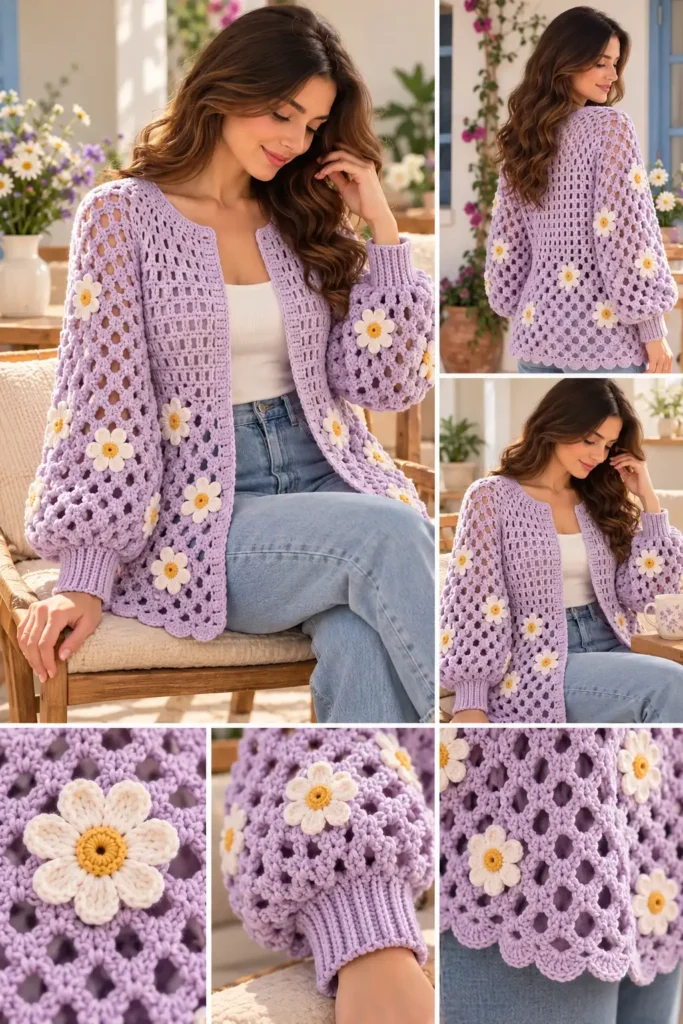
Table of Contents
About This Crochet Sweater Design
The finished cardigan is designed for an adult bust of approximately 88–94 cm, with about 8–14 cm of positive ease. The total body coverage is approximately 102 cm.
The finished body length is around 62 cm, while the sleeves measure approximately 40 cm when the cuffs are included.
Construction is relatively straightforward for crocheters who are already comfortable working garments in rows. The main pieces consist of:
- One back panel
- Two front panels
- Two sleeves
- Ribbed cuffs
- A continuous front and neckline border
- Twelve five-petal flower appliqués
The back and front panels are crocheted from the shoulders downward. After the body pieces are completed, they are joined at the shoulders and sides. The sleeves are worked flat before being seamed and attached to the armholes.
The source classifies this project as intermediate. Familiarity with basic stitches, increases, flat crochet, repeated mesh patterns, and seaming will be helpful.
Materials for the Crochet Sweater
The original design uses a smooth DK-weight cotton-blend yarn with approximately 220 meters per 100 grams.
For the main cream fabric, the project calls for approximately 700 g / 1540 m of yarn. An additional 100 g / 220 m of butter-yellow yarn is listed for the contrasting flower centers.
The recommended hooks are:
- 4 mm crochet hook for the main fabric
- 3.5 mm crochet hook for cuffs and finishing
Other supplies include a tapestry needle, scissors, measuring tape, and eight stitch markers.
The source also mentions an optional decorative version using 12 sew-on imitation pearls and strong sewing thread.
Gauge and Finished Measurements
Checking gauge is especially important for this garment because both the width and length affect how the cardigan hangs.
For the smaller mesh fabric, the stated gauge is:
16 stitch positions (8 mesh cells) × 10 rows = 10 cm
For the larger lattice fabric:
4 arches × 10 rows = 10 cm, measured after light blocking.
The upper back is intended to measure approximately 51 cm wide, while each front panel is approximately 26 cm wide.
Because the two openwork textures behave differently, making a generous swatch before beginning the garment can help reveal how the chosen yarn responds to washing and blocking.
The source recommends making a swatch of at least 15 × 15 cm, washing and drying it as the finished garment will be treated, and then measuring an unstretched 10 cm section in the center.
These dimensions are intended as blocked measurements. Cotton-based lace can also relax with wear, so the final dimensions should be checked after blocking.
Crochet Terminology and Abbreviations
The pattern uses US crochet terminology.
The principal abbreviations listed in the original instructions include:
- ch – chain
- st(s) – stitch(es)
- sp – space
- sl st – slip stitch
- sc – single crochet
- hdc – half double crochet
- dc – double crochet
- tr – treble crochet
- BLO – back loop only
- RS – right side
- WS – wrong side
- rep – repeat
- inc – increase
- sc2tog – single crochet two stitches together
The design also incorporates small mesh, a larger lattice texture, back-loop ribbing, and optional decorative edging.
Rather than reproducing the complete stitch sequences and row-by-row pattern, the sections below explain how these elements work together in the finished garment.
How the Cream Daisy Cardigan Is Constructed
Understanding the construction before picking up your hook makes this crochet sweater much easier to visualize.
Back and Front Panels
The body begins with three separate pieces: one back panel and two front panels.
Each panel starts at the shoulder and progresses downward. The upper body is worked in a small mesh pattern, producing a relatively structured open fabric.
The two front pieces also incorporate shaping along their neckline edges. Once they reach their intended width, the fronts continue straight before transitioning into the lower lace section.
Below the upper body, all three panels change to a larger lattice pattern. This creates a noticeably airier texture and gives the lower half of the cardigan more visual movement.
The target width is approximately 51 cm for the back and 26 cm for each front panel.
Sleeves
Both sleeves are crocheted flat.
Unlike the upper body, the sleeves primarily feature the larger lattice texture, helping maintain the cardigan’s light, open appearance.
After crocheting, each sleeve is seamed lengthwise to create a tube. The sleeve is then positioned with its seam at the underarm and sewn evenly around the armhole.
Ribbed Cuffs
A smaller 3.5 mm hook is used for the cuffs.
The ribbing is created with single crochet worked through the back loop, producing narrow vertical-looking ridges once the strip is turned into a cuff.
Each finished cuff is intended to measure approximately 5 cm deep and 20 cm around before it is joined.
The sleeve opening is gathered evenly to meet the smaller cuff circumference, creating gentle fullness near the wrist.
Daisy Appliqués
The flowers provide the defining decorative feature of this cardigan.
The source uses 12 five-petal daisies, each measuring approximately 5 cm across when made in cardigan-weight yarn.
The flower centers are worked in butter yellow, with cream used for the petals. Once completed, the motifs are blocked flat before being sewn onto the cardigan.
Instead of concentrating all the flowers in one area, they are distributed over the fronts, back, and sleeves. Avoiding the underarm areas helps keep the embellishments away from places where they could be uncomfortable or experience excessive friction.
Assembling the Cardigan
Assembly begins after the individual body and sleeve pieces are complete.
The front panels are first joined to the back at the shoulders while leaving the central portion open for the neckline. The side seams are then sewn while preserving approximately 20 cm from the shoulder for each armhole.
Each flat sleeve is seamed into a tube and attached to its corresponding armhole. The ribbed cuffs can then be joined into rings and sewn to the sleeve openings while distributing the sleeve fabric evenly around them.
Before moving to the decorative finishing, it is worth checking that both shoulders sit evenly, the sleeves have comfortable movement, and the two open front edges hang symmetrically.
Finishing the Open Front and Edges
A 3.5 mm hook is also used for the finishing work.
The design includes a continuous border around the open fronts, neckline, and hem. This border helps stabilize the lace fabric and gives the cardigan a more defined outline.
The original project also offers optional shell or picot-style decorative finishes. These details can be placed along selected edges while keeping the front and neckline relatively simple so the border lies flat.
After the edging is complete, the daisy appliqués are securely sewn into place.
Blocking and Finishing
Once all construction and decorative work is complete, every yarn end should be securely woven into the fabric.
The cardigan is then wet-blocked flat. Particular attention should be paid to aligning the side seams and making both sleeves the same length.
The lower lattice should not be aggressively stretched during blocking. Instead, its width should remain consistent with the upper mesh section. Overstretching open lace can significantly change the silhouette.
After drying, the target measurements are approximately:
- Body length: 62 cm
- Sleeve length including cuffs: 40 cm
- Total body coverage: 102 cm
Because cotton lace can relax after being worn, checking the measurements again after a short period of wear can also be useful.
Caring for the Finished Cardigan
The yarn manufacturer’s care instructions should always take priority because fiber blends can require different treatment.
When the yarn label does not specify otherwise, the source recommends cool hand washing with mild detergent and drying the cardigan flat away from direct heat.
Wet crochet fabric should be supported when lifted rather than allowed to hang under its own weight. Avoid wringing the garment, as this can distort the open mesh and lattice stitches.
Any attached flowers or other decorative elements should also be checked periodically to make sure they remain securely fastened.
Tips for a Neater Finished Cardigan
Swatching both lace textures is worthwhile because the smaller mesh and larger lattice do not necessarily behave identically after washing.
Stitch markers can also make garment construction easier. They are useful for identifying neckline shaping, armhole positions, and important points along the finishing border.
Counting regularly is particularly valuable when working open mesh. A missed stitch or accidental increase can subtly alter the width and become much more obvious several rows later.
Finally, use a restrained approach to blocking. The goal is to open and even the lace rather than dramatically stretch it. Keeping the lower lattice aligned with the width of the upper mesh helps preserve the intended silhouette.
With its contrasting lace textures, ribbed cuffs, and delicate flower details, this cream cardigan offers an interesting approach to a handmade crochet sweater. The construction remains approachable for an intermediate crocheter while providing enough texture and finishing work to make the project engaging from the first panel to the final appliqué.
Conclusion
The cream daisy lace cardigan shows how a crochet sweater can combine practical garment construction with delicate openwork and decorative details. The contrast between the structured upper mesh and airy lattice fabric gives the cardigan visual interest, while the ribbed cuffs and floral appliqués create a polished handmade finish.
For an intermediate crocheter, the project offers useful experience with separate garment panels, lace textures, seaming, edging, blocking, and appliqué placement. Careful gauge checking and gentle blocking are especially important for maintaining the intended proportions of the openwork fabric.
For the complete stitch sequences, shaping, and row-by-row instructions, consult the original Cream Daisy Lace Cardigan pattern.
Frequently Asked Questions
Is this crochet sweater suitable for beginners?
The source classifies the cardigan as an intermediate project. It is better suited to crocheters who are already comfortable working in rows, following repeated lace patterns, shaping garment pieces, seaming, and completing finishing details.
Why is gauge important for this lace cardigan?
Gauge helps determine whether the finished garment will match the intended proportions. Because the cardigan combines two different openwork textures, checking both stitch and row gauge after washing and blocking the swatch can help prevent unexpected changes in size.
Are the daisy flowers crocheted separately?
Yes. The daisy motifs are made separately and attached to the completed cardigan. This allows the flowers to be arranged across the garment after the main construction and finishing work are complete.
Should the cardigan be blocked after assembly?
Yes. The finished cardigan is wet-blocked flat to help even the lace, align the seams, and settle the overall shape. The openwork should be handled gently rather than stretched aggressively, particularly in the larger lattice sections.
Leave a Reply