
Crochet Pattern for a Cozy Autumn Flower Table Runner
A handmade table runner can completely change the mood of an autumn table. This Pattern focuses on a runner assembled from individual crochet flowers, combining rich seasonal shades with textured stitches and open decorative spaces. Instead of creating one continuous rectangular fabric, the project builds the final piece from separate motifs that are shaped, arranged, and joined together.
The result is a flexible crochet project that can be adjusted according to the size of the table and the number of motifs you decide to make.
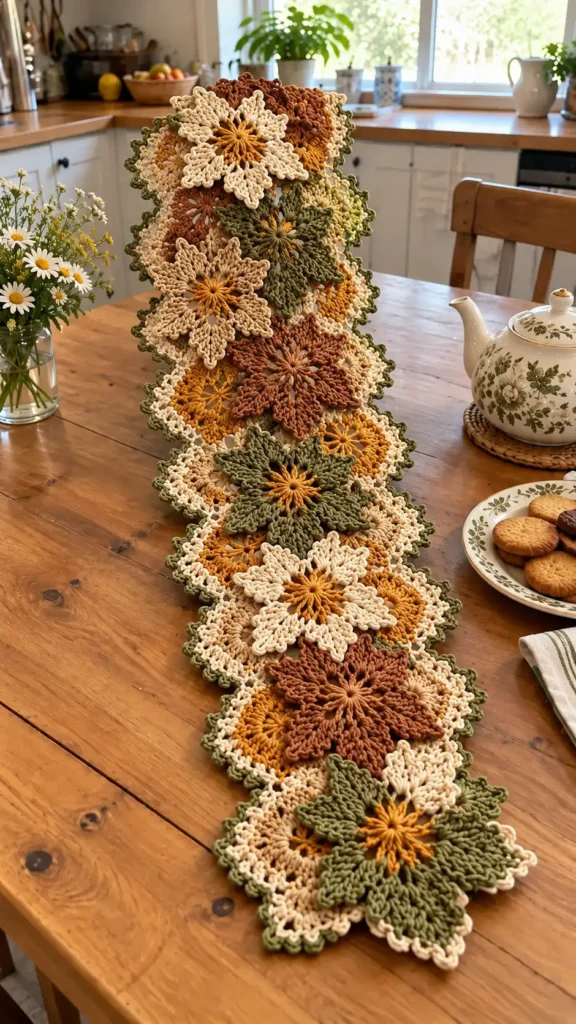
Table of Contents
Understanding the Floral Pattern
The main feature of the runner is its collection of large eight-point flower motifs. Each flower is crocheted separately, beginning at the center and expanding outward.
The motifs combine solid textured areas with lighter lace sections. Puff and cluster stitches provide dimension, while chain spaces help keep the flowers visually open.
Warm shades such as gold, pumpkin orange, deep red, and burgundy are used in the example shown by the source. Changing the color arrangement from one flower to another can give every motif a slightly different appearance while maintaining a coordinated autumn theme.
Supplies for the Project
The source specifies #4 worsted-weight cotton or cotton-blend yarn.
Approximately 250–350 g of yarn is listed for a runner similar to the example, divided among several colors. The stated quantities include 120–140 g for the primary accent shade, 80–100 g of orange, 50–80 g of deep red, and 30–50 g of burgundy or wine.
An additional 10–20 g of a coordinating neutral shade may be used for joining or edging.
A 4.0 mm (G) crochet hook is used for the main motifs. The source also lists a 3.5 mm (E) hook as an optional tool when a firmer edge is desired.
Other useful supplies include scissors, a yarn needle, stitch markers, a measuring tape or ruler, blocking mats, and rust-proof pins.
Skills Used in This Pattern
This project is classified as intermediate by the source. It combines several crochet techniques within the same floral construction.
The instructions use US crochet terminology and involve techniques such as magic ring construction, chains, slip stitches, single crochet, half double crochet, double crochet, treble crochet, puff stitches, clusters, picots, and color changes.
Because several techniques appear within each motif, familiarity with reading crochet instructions and identifying repeated sections will make the project easier to manage.
Creating the Individual Flowers
Each flower is worked flat from the middle toward the outside.
The center establishes the basic structure before additional sections create the petals and decorative spaces. Textured stitches add volume to the floral design, while the outer portions introduce a more open appearance.
After blocking, the source states that a large flower measures approximately 6.5–8 inches (16–20 cm) across, depending on yarn and tension.
Arranging the Motifs
One advantage of motif-based crochet is the ability to decide on the overall layout before completing the final assembly.
For a traditional narrow table runner, the flowers can be positioned in a single line. A longer table can accommodate additional motifs, while a shorter arrangement can function as a decorative centerpiece.
The source also discusses creating a wider version by arranging motifs in parallel columns.
Optional smaller connector motifs can be positioned between larger flowers where additional support or visual continuity is needed.
Joining the Flowers
Once enough flowers have been completed, they are brought together to form the runner.
The source describes a join-as-you-go method that connects new motifs to completed ones through corresponding outer loops. Sewing the blocked flowers together afterward is another option mentioned for assembly.
The joining tension matters. Connections that are pulled too tightly can distort the petals and cause the runner to gather instead of lying flat.
Arranging all motifs on a flat surface before joining can also make it easier to check spacing and overall balance.
Adding the Decorative Border
The outer border gives the assembled flowers a more unified finish.
The source combines single crochet with chain loops and small picot details around the perimeter. Since the runner can contain different numbers of motifs, there is no single stitch count that applies to every finished version.
The edging instead follows the actual outline created by the assembled flowers.
Why Blocking Matters
Blocking is particularly useful for floral crochet because individual petals can look uneven immediately after they leave the hook.
The source recommends blocking the large motifs before assembly. The flowers can be dampened, arranged on blocking mats, and pinned carefully so their petals and decorative points are evenly positioned.
They should remain pinned until completely dry.
A second blocking session after joining and edging can help the entire runner settle into its final shape.
Keeping the Motifs Consistent
When several identical flowers are required, small differences in tension can become noticeable once they are placed beside one another.
Using the same hook and maintaining consistent tension throughout the project helps keep motif sizes similar. Measuring completed flowers after blocking can also reveal significant differences before assembly begins.
Stitch markers are useful for tracking repetitive sections. They can help identify the beginning of a round and make it easier to notice a missing repeat before too much work has been completed.
Puff and cluster stitches should also be worked consistently so the textured areas have a similar height and fullness across every motif.
Choosing Colors for the Runner
The autumn palette shown in the source is only one possible arrangement.
Using several related warm shades can emphasize the individual flowers, while repeating the same combination throughout the project creates a more uniform appearance. The source also mentions monochrome and ombré approaches as possible alternatives.
When using several yarn colors or brands, checking whether darker shades release dye before washing the finished runner can help protect lighter sections.
Caring for the Finished Crochet
The source recommends gently hand washing the runner in cool water and allowing it to dry flat.
After washing, reshaping the petals while the crochet is damp can help restore their definition. Cotton pieces may also be lightly ironed when appropriate, with a pressing cloth placed between the iron and the crochet.
For storage, keeping the runner flat or carefully rolled can help prevent the decorative edges from becoming crushed.
A Flexible Seasonal Crochet Project
The strongest feature of this Pattern is its modular construction. Each flower is an individual project, yet several motifs can be combined into a much larger decorative piece.
The number of flowers determines much of the runner’s final length, while different arrangements can produce narrow or wider versions. Color changes offer another way to personalize the design without changing its basic floral structure.
Conclusion
This autumn floral table runner brings together textured crochet, seasonal color, and flexible motif construction in one decorative project. Because the Pattern is built from individual flowers, crocheters can focus on one motif at a time before arranging and joining the completed pieces.
Careful blocking and consistent tension help the floral shapes sit neatly together and highlight their layered details. For crocheters comfortable with intermediate techniques, the project offers an attractive way to explore dimensional motifs while creating practical seasonal décor.
Frequently Asked Questions
Is this crochet project suitable for beginners?
The source classifies the project as intermediate. It involves several techniques, including textured stitches, color changes, motif construction, joining, and decorative finishing. Crocheters who already understand basic stitches and can follow motif instructions should find the project more approachable.
Can I change the colors of the floral motifs?
Yes. The colors can be adapted to suit different decorating styles. The source specifically mentions alternatives such as monochrome and ombré arrangements, so the autumn palette does not have to be followed exactly.
Can I make the table runner longer or shorter?
Yes. Its motif-based construction allows the overall arrangement to be adjusted by changing the number of flowers. The final dimensions will depend on the motifs used and how they are arranged.
Should the crochet flowers be blocked before joining?
The source recommends blocking the individual motifs before assembly. This helps define the petals and decorative sections while making it easier to arrange the flowers evenly. The completed runner can also be blocked again after joining and edging.
Leave a Reply