
Crochet Blanket: Beautiful Lavender Sunflower Granny Square Design
A handmade crochet blanket filled with sunflowers and soft lavender tones brings warmth, texture, and a cheerful floral touch to a baby’s nursery. This granny square design combines golden-yellow petals, rich brown flower centers, delicate purple framing, and a creamy scalloped border.
The blanket is assembled from 16 individual sunflower granny squares, making it a manageable project for crocheters who enjoy working on smaller motifs. Each square features a raised floral center surrounded by a traditional square-shaped frame.
Designed as an intermediate-level project, this blanket is also suitable for confident beginners who already understand basic crochet stitches, color changes, and working in rounds.
According to the original pattern, each square takes approximately 45 to 75 minutes to complete, while the entire blanket requires around 20 to 30 hours of crocheting.
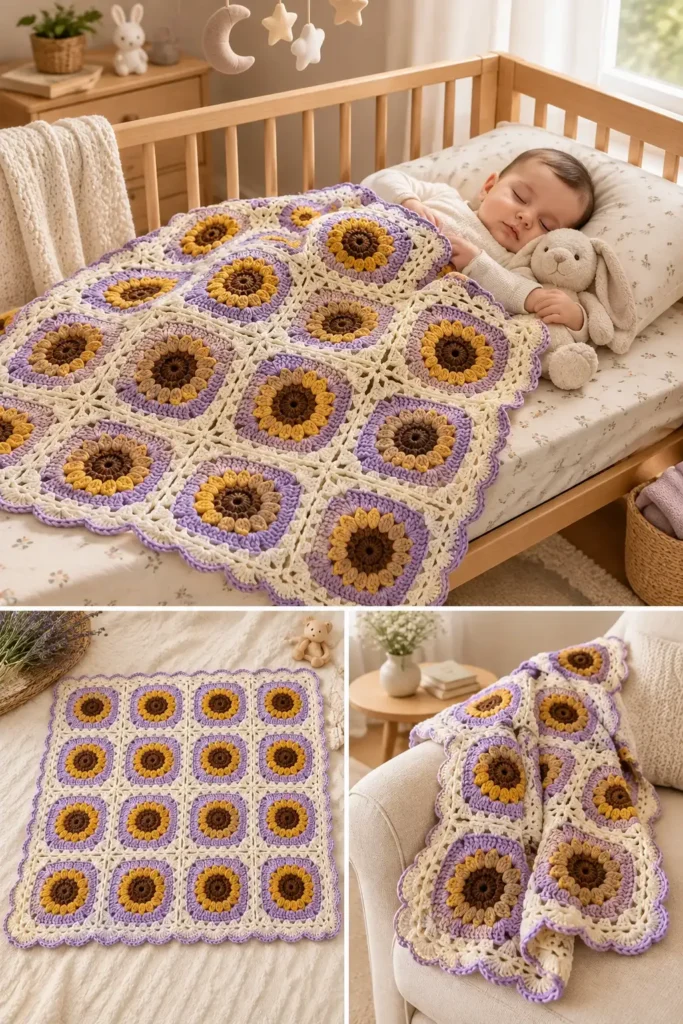
Table of Contents
What Makes This Sunflower Crochet Blanket Special?
The defining feature of this blanket is its combination of dimensional flowers and soft geometric framing.
Each sunflower begins with a dark brown circular center. Golden petals are then formed around it using textured cluster stitches. Lavender stitches transform the circular flower into a square, while a cream-colored outer round provides a consistent background for joining the motifs.
The finished design offers several appealing features:
- Dimensional sunflower petals: Raised stitches create noticeable floral texture.
- Soft color contrast: Golden yellow and brown stand out against lavender and cream.
- Modular construction: Individual squares can be completed separately before assembly.
- Coordinated edging: A lavender foundation and cream scalloped border frame the finished piece.
- Flexible dimensions: The number of squares can be adjusted to create different blanket sizes.
Because the design uses separate motifs, crocheters can check the shape and tension of each square before joining the entire blanket.
Materials Needed for the Crochet Blanket
The original design uses Category 4 worsted-weight yarn in four colors. A smooth yarn is particularly helpful because it allows the sunflower petals and surrounding stitches to remain clearly defined.
Yarn Requirements
| Color | Approximate yardage |
|---|---|
| Dark brown (Color A) | 110 yards / 101 m |
| Golden yellow (Color B) | 220 yards / 201 m |
| Lavender (Color C) | 300 yards / 275 m |
| Cream or off-white (Color D) | 350 yards / 320 m |
| Total | 980 yards / 897 m |
Crochet Hook and Accessories
- US J-10 (6.0 mm) crochet hook
- Yarn needle for securing loose ends
- Scissors
- Locking stitch markers or split-ring markers
- Blocking mats
- Rust-resistant blocking pins
Blocking supplies are recommended because the completed squares need consistent dimensions for neat assembly.
Recommended Yarn Options
The source suggests several yarn choices for this project.
Lion Brand Pound of Love: A 100% acrylic worsted-weight yarn with approximately 1,020 yards per skein. Its smooth texture and machine-washable construction make it a practical option for baby projects.
Paintbox Yarns Simply DK: A 100% acrylic DK-weight yarn that the original article suggests using with two strands held together.
Cascade 220 Superwash: A worsted-weight superwash wool that offers defined stitches and a flexible finished fabric.
When selecting yarn, prioritize a smooth surface, comfortable texture, and care instructions appropriate for a frequently washed baby blanket. Highly fuzzy or textured yarns can obscure the sunflower details.
Gauge and Finished Blanket Measurements
Checking gauge is important when working with multiple granny squares. Even small differences in tension can become noticeable when the motifs are joined.
The reference pattern specifies the following gauge using a 6.0 mm hook:
- 14 double crochet stitches = 4 inches (10 cm)
- 8 rows = 4 inches (10 cm)
- Each blocked granny square = 7 × 7 inches (approximately 18 × 18 cm)
Finished Size
| Stage | Approximate dimensions |
|---|---|
| Before blocking | 30 × 30 inches (76 × 76 cm) |
| After blocking | 32 × 32 inches (81 × 81 cm) |
| Individual blocked square | 7 × 7 inches (18 × 18 cm) |
These are the measurements reported by the original designer. Actual dimensions may vary depending on yarn, tension, and blocking.
If your sample square is smaller than expected, a larger crochet hook may help. If it is too large, try a smaller hook.
Skill Level and Techniques
This sunflower granny square blanket is classified as an intermediate crochet project.
Although the construction relies on familiar stitches, the floral motifs require accurate stitch placement and consistent tension.
Crocheters should be comfortable with working in the round, changing yarn colors, making cluster stitches, shaping square corners, joining motifs, and finishing borders.
The raised sunflower petals are the most distinctive technique. They are formed in chain spaces and create a three-dimensional effect rather than a flat floral design.
Crochet Stitch Abbreviations
The original pattern uses US crochet terminology.
| Abbreviation | Meaning |
|---|---|
| ch | Chain |
| sl st | Slip stitch |
| sc | Single crochet |
| hdc | Half double crochet |
| dc | Double crochet |
| tr | Treble crochet |
| st / sts | Stitch / stitches |
| sp | Space |
| ch-sp | Chain space |
| sk | Skip |
| rep | Repeat |
| pm | Place marker |
| beg | Beginning |
| yo | Yarn over |
| rnd | Round |
| RS | Right side |
Understanding these abbreviations will make it easier to follow the complete instructions, particularly when shaping the sunflower petals and working the outer border.
Special Crochet Stitches Used in the Design
Raised Sunflower Petals
The sunflower petals are created using a combination of single crochet and a two-double-crochet cluster.
These stitches are worked into designated chain spaces around the flower center. The cluster technique brings the stitches together at the top, producing a rounded, raised shape.
A chain stitch separates the petals and helps preserve their individual definition.
Consistent tension is important because uneven clusters may affect the appearance of the flower.
Decorative Shell Stitch
The shell stitch forms the blanket’s scalloped outer edge.
In this design, a shell consists of five double crochet stitches worked into one stitch or space.
Repeated along the border with smaller stitches between the shells, this technique creates the gently curved finish surrounding the blanket.
How the Sunflower Granny Squares Are Constructed
The blanket uses 16 matching granny squares arranged into four rows and four columns.
Each motif is completed in five rounds, with the yarn colors changing as the sunflower develops.
The following overview explains the construction without replacing the designer’s detailed stitch instructions.
Round 1: Creating the Brown Flower Center
The sunflower begins with dark brown yarn worked into a small circular foundation.
Double crochet stitches form the center of the flower, creating a compact base for the surrounding petals.
The brown yarn is fastened off before the next color is introduced.
Round 2: Preparing the Golden Petal Foundation
Golden-yellow yarn is attached around the brown center.
This round uses single crochet stitches and chain spaces to establish the positions where the raised sunflower petals will be worked.
Evenly spaced chain openings are essential for maintaining a balanced floral shape.
Round 3: Forming the Textured Sunflower
The golden yarn continues into the petal round.
Cluster stitches are worked into the prepared chain spaces to create the flower’s dimensional petals.
Once this stage is complete, the motif has a recognizable sunflower appearance, with a dark center surrounded by golden petals.
Round 4: Adding the Lavender Square Frame
Lavender yarn changes the circular sunflower into a square.
The pattern establishes four corners around the flower using groups of double crochet stitches and corner chain spaces.
This round is particularly important because it determines the overall shape of the granny square.
The fabric should remain reasonably flat, without excessive curling or rippling.
Round 5: Completing the Cream Outer Frame
The final motif round uses cream-colored yarn.
Double crochet stitches extend the sides of the square, while the corner spaces maintain its shape.
The cream framing creates a consistent edge around each sunflower and provides a neutral background for assembling the blanket.
All 16 motifs are completed before joining.
Joining the Sunflower Granny Squares
Once all the motifs are finished, they are arranged in a 4 × 4 layout.
Position the squares with their right sides facing upward and check that the sunflowers are oriented consistently.
The reference design uses a flat slip stitch joining method with cream yarn.
Flat Slip Stitch Joining Method
This technique connects neighboring motifs along their corresponding edges.
Slip stitches are worked through selected loops of both squares, forming a relatively flat connection that coordinates with the cream outer rounds.
The designer recommends joining the squares into rows before connecting those rows into the full blanket.
Pay particular attention to the points where four squares meet. Neatly aligned intersections help maintain the regular grid and keep the sunflower motifs evenly spaced.
Adding the Decorative Blanket Border
After assembly, the blanket receives a two-round border.
The border combines the lavender and cream shades already used in the granny squares, creating a coordinated finish.
First Border Round: Lavender Foundation
The first border round uses lavender yarn and double crochet stitches.
It follows the outside edges of the joined squares, incorporating the outer corners and the points where individual motifs meet.
This round provides a continuous foundation for the decorative edging.
Second Border Round: Cream Scalloped Finish
The final border round uses cream yarn to create a series of shell-shaped scallops.
The shells form a gently curved edge around the blanket, while smaller stitches provide separation and shape the corners.
The result is a decorative finish that complements the rounded sunflower petals without overwhelming the floral motifs.
The precise border stitch sequence and corner instructions are available in the original pattern.
Adjusting the Crochet Blanket Size
One advantage of a granny square construction is the ability to change the blanket’s dimensions by adding or removing motifs.
The reference article provides several alternative layouts.
| Blanket variation | Granny square layout | Approximate finished size |
|---|---|---|
| Small lovey | 3 × 3 (9 squares) | 22 × 22 inches |
| Original baby blanket | 4 × 4 (16 squares) | 32 × 32 inches |
| Larger lap blanket | 5 × 5 (25 squares) | 37 × 37 inches |
| Rectangular crib blanket | 4 × 6 (24 squares) | 30 × 44 inches |
These measurements are the designer’s estimates and may differ with individual gauge and finishing.
Changing the number of motifs also changes the yarn requirements. Plan for additional yarn when enlarging the blanket, including enough for joining and edging.
For infant use, remember that blankets and other loose bedding should not be placed in a baby’s sleep space. Handmade blankets are better reserved for supervised activities or use by older children.
Finishing and Blocking the Blanket
Finishing helps the individual squares sit evenly and gives the joined blanket a more consistent shape.
Securing Loose Yarn Ends
Use a yarn needle to weave loose ends through stitches on the wrong side of the fabric.
Work the ends securely through several stitches, changing direction to help prevent them from slipping out during use or washing.
Trim the remaining yarn only after the ends are properly secured.
Wet Blocking
The original pattern recommends wet blocking to improve stitch alignment and define the square shapes.
Its finishing process involves gently soaking the blanket in cool water, removing excess moisture without twisting the fabric, and positioning it on blocking mats.
The motifs are then adjusted toward their intended measurements and secured with rust-resistant pins.
Allow the blanket to dry completely before removing the pins. The source estimates a drying period of approximately 12 to 24 hours, depending on conditions.
Always check the yarn manufacturer’s instructions before wet blocking, particularly when using different fiber types.
Caring for Your Handmade Sunflower Blanket
Proper care helps preserve the blanket’s shape, texture, and colors.
For machine-washable yarns, the reference recommends washing on a gentle cycle using cool water.
Lay the blanket flat to dry rather than tumble drying it.
When storing the finished piece, fold it loosely and keep it away from prolonged direct sunlight, which may contribute to color fading.
Because the design includes raised petals and joined motifs, inspect the blanket periodically for loose ends or damaged stitches, especially when it is intended for a young child.
More Crochet Projects to Explore
If you enjoy working with granny squares, decorative stitches, and colorful yarn combinations, Bunny Patterns also features other projects that use related crochet techniques.
Among the projects mentioned alongside the sunflower blanket are:
- Boho Rainbow Granny Square Tote
- Lavender Dream Ankle Socks
- Mustard Yellow Duck Toilet Paper Cozy
- Charcoal Gray Modern Crochet Backpack
The lavender sunflower design is a satisfying way to combine textured floral motifs with classic granny square construction. Its separate squares, coordinated colors, and scalloped edging create a distinctive handmade blanket while allowing the work to progress one sunflower at a time.
Conclusion
The Lavender Sunflower Granny Square crochet blanket combines cheerful floral details, soft lavender shades, and classic granny square construction in a charming handmade project. Its raised sunflower petals, coordinated cream borders, and delicate scalloped edging create a textured design suitable for gifting or decorating a nursery.
Working with individual squares makes the project easier to organize, while the modular construction allows crocheters to adjust the finished size. With consistent tension, careful joining, and proper blocking, the floral motifs can come together into a neat, coordinated blanket.
Whether you are creating a thoughtful handmade gift or exploring textured granny square techniques, this sunflower design offers an enjoyable opportunity to practice crochet skills and produce a beautiful finished piece.
Frequently Asked Questions About the Crochet Blanket
1. Is the Lavender Sunflower Crochet Blanket Suitable for Beginners?
The pattern is classified as intermediate, but confident beginners who understand basic crochet stitches may be able to complete it. Familiarity with working in rounds, changing colors, and making double crochet clusters will be helpful. Practicing one sunflower granny square before starting the full blanket can make the construction easier to understand.
2. Can I Make This Crochet Blanket Larger or Smaller?
Yes. The blanket uses individual sunflower granny squares, so you can change its size by adjusting the number of motifs. The original design arranges 16 squares in a 4 × 4 layout. Adding more squares creates a larger blanket, while using fewer produces a smaller project. Remember that changing the layout also affects yarn requirements and the amount of joining and border work.
3. Why Should I Block the Granny Squares Before Joining Them?
Blocking helps the granny squares achieve more consistent dimensions and improves the alignment of their edges and corners. This is especially useful for a blanket assembled from multiple motifs. Squares with similar dimensions are easier to join neatly, reducing uneven seams and helping the finished blanket lie flatter.
4. How Do I Keep the Sunflower Petals Looking Neat?
Maintain consistent yarn tension when working the cluster stitches that form the raised petals. Avoid pulling the yarn too tightly, as this can compress the floral texture. Using smooth yarn also helps the individual stitches remain visible. After completing the blanket, follow the yarn manufacturer’s washing instructions and dry it flat to help preserve its shape.
Leave a Reply